
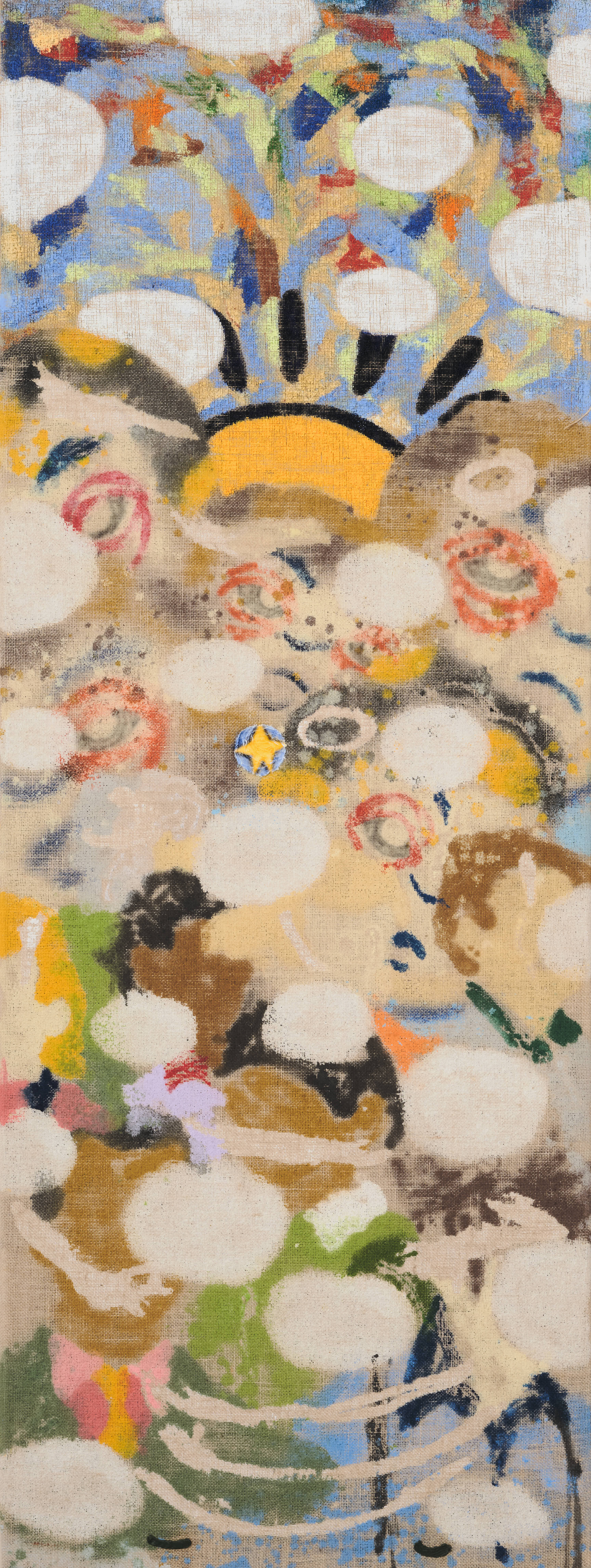
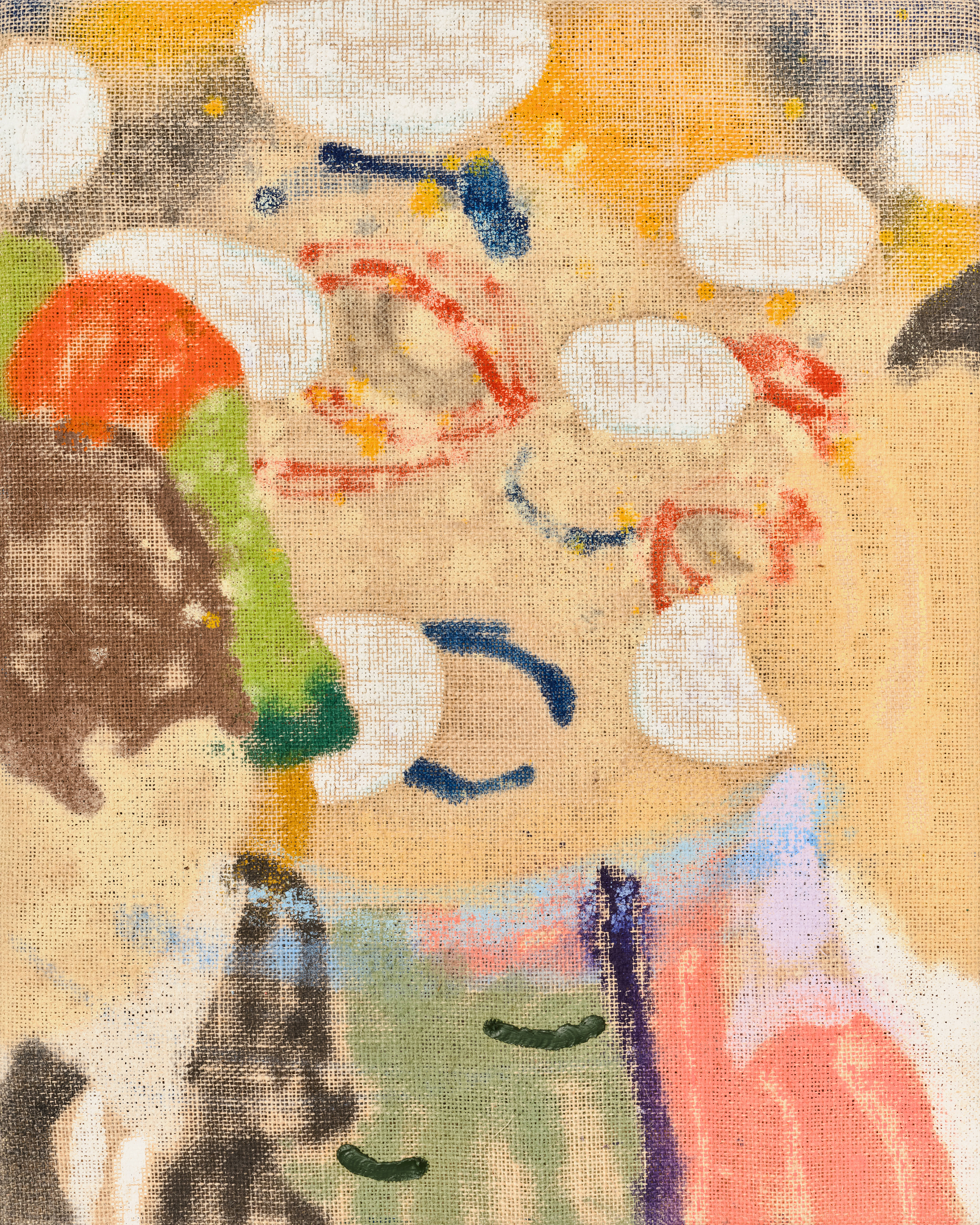
Appreciating the work of Nicklas Johannes requires a double gaze; that of the mass that invades the painting, suffocating it, and that of all those who populate the physical gallery room. If we think of an opening and all the human movement it entails, we will likely enter a dialogue of mirrors, and it is precisely this human landscape that Nicklas inhabits day to day: he combines his artistic practice with a day job at IKEA, a commercial environment that has kept him immersed in the constant flow of the masses for the last ten years.
Selskabsdyr is a Danish term composed of two concepts: community and animal instinct. The person to whom this adjective is applied is prone to wanting to immerse themselves in this mass and talk to strangers, easily breaking down social barriers. Nicklas Johannes’s paintings thus represent the contradiction between that extroverted impulse and the anxiety generated by the group, erasing faces and serializing sad gazes.
However, during one of our video calls, premiering a new studio in Aalborg, Nicklas tells me that narrative is no longer part of his creative process, at least, not consciously. It is true that at the beginning of his career he always tried to incorporate stories into his canvases, but over time he realized that his life already held enough depth to leave no room for invention. Ultimately, what matters is the very act of painting.
If I feel like painting a blue line in the center of the canvas, I do it.
It is this love for the medium that drove him to experiment, incorporating the process of trial and error into his practice. Nicklas turns the camera and shows me the back of the canvas; it is almost entirely painted in oil, thereby generating this misty, phantasmagoric appearance on the front. He understands the beauty of this mistake as the discovery of his own style. This highly spontaneous approach stems from his past as a poet: by burning all his texts at nineteen, Nicklas wiped the slate clean, allowing himself to create from a total tabula rasa.
The constant repetition of his technique as well as his symbols comes from idols like Jasper Johns, a master of burin engraving, lithography, and silkscreen printing, who unified his serial process with the pictorial one, prioritizing subtle variation between his pieces. Nicklas does the same; the clouds vary in distribution, the clothing changes…
Jean Dubuffet is another influence that comes up in our conversation, especially when talking about Samenwerking met onbekend kind (Collaboration with an unknown child). Nicklas tells me that the sketch for this piece emerged during his workday, from a chance encounter with a lost drawing under the cold fluorescent lights of the Swedish warehouse. He confesses that he actually doesn't know the creator's age, but by the strokes, it would seem to be a child.
Dubuffet, theorist of the so-called art brut, argued that its creators were figures detached from all artistic culture, children among them. Even so, in childhood one is never entirely exempt from references, as imitation is inherent to that young age. Be that as it may, for Nicklas, instantaneous creation, gesturality, primary colors, experimentation... these are elements that emerge in childhood and are of vital importance within his compositions.
This collaboration thus enhances the figure of the stranger, recurrent throughout art history; in every portrait, there is an unknown person. The pictorial genre itself involves the appreciation of a foreign face whose identity is completely ancient or distant to us. We will never know who hides behind the phantasmagoric features of the Danish painter's canvases. It doesn't matter; there is a bit of us within that otherness. In fact, Nicklas himself is represented through the silhouette of Piero Manzoni, as we can sense in the self-portrait Newt (My name is Nicklas).
You are me, I am you. We are the mass. Selskabsdyr is a positioning in the midst of the audience, a resounding "Here I am!"
Curated text by Paula Tomasini Collado